GREEN PIGMENTS
Introduction
Green was an important colour in Persian manuscript painting and illumination, appearing in landscapes, vegetation, architectural elements, textiles, decorative details, and other painted features. Scientific examination of Persian manuscripts has identified a variety of materials used to obtain green, including naturally occurring copper greens, mixtures of blue and yellow colourants, and, from the nineteenth century, imported synthetic pigments. Historical and scientific evidence therefore demonstrates that Persian artists had access to more than one means of producing green.
Despite this diversity, the only green pigment described repeatedly in Persian historical technical treatises is the copper-based pigment known as zangār (زنگار). Recipes for its preparation occur in Persian sources over many centuries, demonstrating the importance and continuity of copper-green technology within the Persian artistic tradition. The repeated attention given to the manufacture of zangār contrasts with the relative silence of the treatises concerning other greens known from scientific analysis, such as malachite and mixtures of yellow and blue. The reason for this selective emphasis remains unclear.
The Persian term zangār requires particular attention. It should not automatically be considered equivalent to the European pigment commonly called verdigris. Verdigris, in its specific chemical sense, refers to copper acetate compounds. In Persian historical recipes, however, zangār functions more broadly for green or blue-green corrosion products obtained from copper or copper alloys under different preparation conditions. Depending on the ingredients and processes employed, these products may contain different copper compounds, including acetates, carbonates, chlorides, or mixtures of these materials. The historical term is therefore retained here rather than translated uniformly as verdigris.
The recipes reveal considerable technological diversity. Copper plates, pieces, filings, and in some cases copper alloys were exposed to different corrosive media and processing conditions. Vinegar occurs frequently, but recipes also employ sal-ammoniac (nūshādar), yogurt, grape juice, lime or citrus juice, and other substances. Processes include prolonged exposure, repeated grinding and drying, heating, suspension in wells, burial in moist soil or horse dung, purification, and refinement. Changes in ingredients and procedures could consequently produce copper-green materials with different colours, compositions, textures, and working properties.
This diversity is particularly evident in Majmūʿah al-Ṣanāyeʿ, which preserves eight recipes or methods for making zangār. The recipes include several named preparations and variant methods, and the surviving copies also preserve differences in terminology and wording. They demonstrate that zangār was not necessarily understood as a single, uniform pigment but as a broader family of related corrosion products and preparations.
Copper-green pigments are also important from a conservation perspective. Copper compounds can contribute to darkening, embrittlement, and deterioration of paper and other organic supports. At the same time, Persian historical recipes sometimes incorporate additional materials and processing methods that may have modified the behaviour of the resulting pigments. The study of complete recipes is therefore important not only for understanding how these colours were made, but also for interpreting their present condition in manuscripts.
The Green Pigments and Paints phase of the Persian Manuscript Materials Digital Database brings together historical textual research and experimental reconstruction to investigate this technological diversity. Selected historical recipes have been reconstructed using their recorded ingredients and procedures. The following sections present the principal copper-green preparation methods and the recipes recorded in Majmūʿah al-Ṣanāyeʿ, together with original texts, English translations, selected experimental reconstructions, observations, and their significance for the study and conservation of Persian manuscripts.
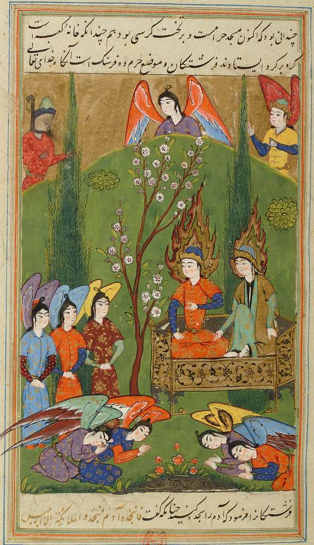
Adam and Eve adored by angels in the Garden of Eden, Persian Safavid manuscript, BnF, 54 f.6. Public domain: